

Table des matières
The Consulting Procurement Playbook Every Category Manager Needs
Consulting often feels like the Wild West of procurement. Unlike IT, logistics, or even marketing, consulting spend rarely follows consistent rules. Senior executives launch projects directly, categories are buried under “professional services,” and suppliers range from global giants to niche boutiques. The result? Fragmented processes, inconsistent governance, and a lot of missed opportunities to generate value.
That’s where a consulting procurement playbook comes in.
Think of it as your rulebook, your GPS, and your best practices manual all rolled into one. A playbook captures the frameworks, tools, and processes needed to source, manage, and get the most out of consulting services. It creates clarity and consistency across the organization, no matter who initiates a project or which supplier is chosen.
But here’s the catch: consulting is different. You can’t just copy-paste a generic procurement playbook and expect results. Because consulting is intangible, strategic, and politically charged, your playbook needs to be designed with the unique characteristics of this category in mind.
In this article, we’ll explore what makes consulting procurement so different, what should go into your playbook, and the best practices category managers can follow to make it a living, evolving tool that drives measurable impact.
By the end, you’ll not only understand how to build a consulting procurement playbook, but also why it can be the single most effective lever to bring structure, maturity, and ROI to one of the most misunderstood spend categories.
Why Consulting Needs Its Own Procurement Playbook
If you already manage categories like IT, logistics, or marketing, you might wonder: why does consulting deserve a playbook of its own? After all, category management principles are universal, right? Not quite. Consulting is unlike almost every other spend area, and that’s precisely why a tailored approach is essential.
1. Consulting is intangible.
When you buy raw materials, you know exactly what you’re getting. When you buy consulting, the “product” is advice, expertise, and change management support. Outcomes are harder to define, measure, and contract. A playbook helps you clarify what “value” means for your organization and how to ensure it gets delivered.
2. The supplier base is fragmented.
From tier-1 global strategy firms to specialized boutiques and independent experts, the consulting market is diverse and highly segmented. Choosing the right supplier depends on the type of project, the scope, and even the political weight of having a “big name” on board. A playbook helps you map this supplier landscape and codify selection criteria.
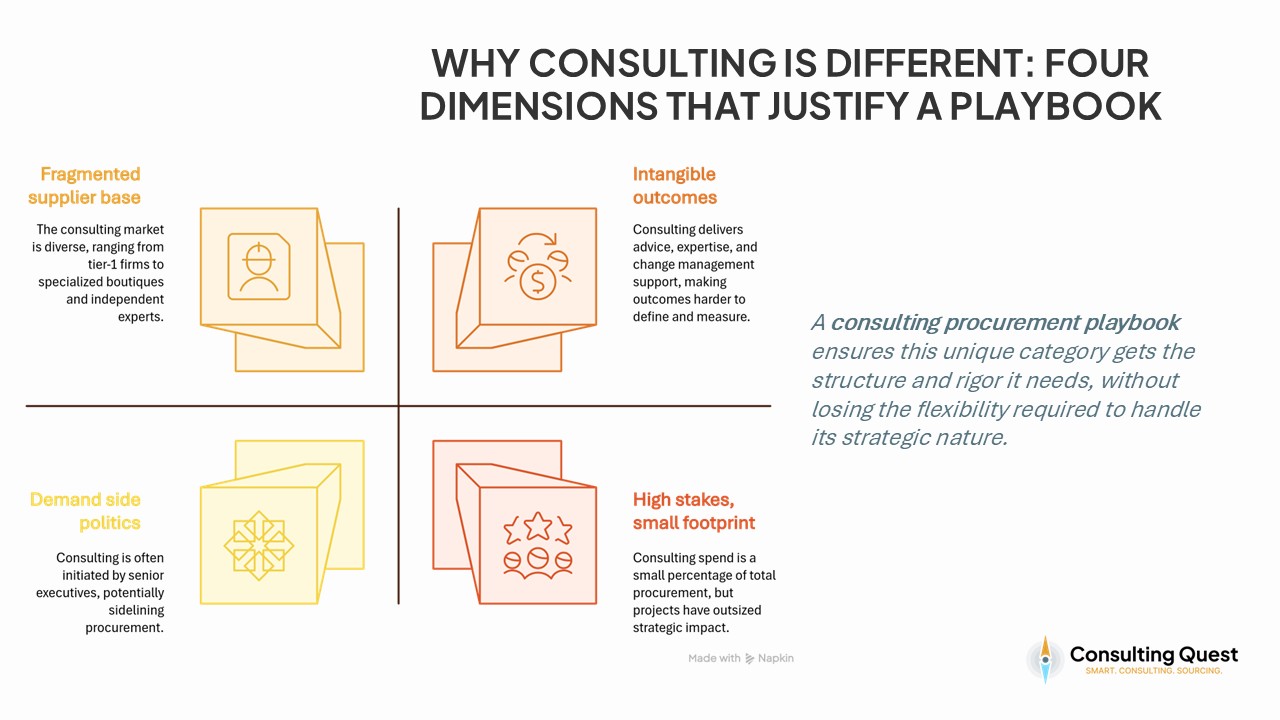
3. The demand side is political.
Unlike office supplies or IT hardware, consulting is often initiated by senior executives. Procurement may only be brought in late, once decisions are already made. A playbook gives procurement a structured way to engage earlier, provide value, and still respect the strategic sensitivities of executive sponsors.
4. High stakes, small footprint.
Consulting spend often represents less than 1% of total procurement, but projects can have outsized strategic impact—reshaping entire business models, markets, or operations. That makes consistency, governance, and ROI measurement critical.
For all these reasons, treating consulting like any other category doesn’t work. A consulting procurement playbook ensures this unique category gets the structure and rigor it needs, without losing the flexibility required to handle its strategic nature.
What Goes Into a Consulting Procurement Playbook
A consulting procurement playbook isn’t a glossy PDF or a stack of generic templates. It’s a living framework that guides how your organization sources, contracts, and manages consulting services. Done well, it becomes the operating system of consulting procurement: giving clarity to business stakeholders, consistency to procurement, and ultimately driving better outcomes from projects.
Here are the six core elements every consulting procurement playbook should cover — with a look at the realities many companies face and how the playbook helps overcome them.
1. Spend & Demand Mapping
The foundation of any playbook is knowing what you actually buy. But in most organizations, consulting spend is buried inside “Professional Services.” It gets lumped together with legal, audit, facilities, or IT outsourcing, making it impossible to distinguish what is truly consulting. To make matters worse, a big chunk hides in time & material contracts. People often argue that “T&M is different from consulting,” but bodyshopping — paying for external expertise by the hour — is consulting too.
The consequence? Procurement leaders underestimate consulting spend by 30–50%, leaving large portions unmanaged and invisible.
A playbook addresses this by:
- Defining what counts as consulting (vs. other services).
- Establishing a taxonomy to categorize consulting spend consistently.
- Creating intake forms to validate demand at the start (“make vs. buy” decisions).
At a basic maturity level, this may mean just agreeing on a clear definition and setting up a spend-tracking process. At an advanced level, it means real-time dashboards, linked taxonomies across systems, and strategic demand planning with finance and transformation teams.
2. Supplier Segmentation & Panel Strategy
The consulting supplier market is highly fragmented. On one end, you have a few large global firms; on the other, thousands of niche boutiques and independent consultants. Many companies design panels poorly — they either go too global (with only a handful of large firms, which kills competition and inflates costs) or too fragmented (with hundreds of suppliers, impossible to govern).
The smarter approach — and one your playbook should codify — is a three-layered panel:
- Global tier: a small number of providers for high-stakes, cross-border transformation.
- Regional tier: specialized firms with depth in a given geography or function.
- Local tier: smaller boutiques or experts for targeted projects.
Within each layer, the playbook should distinguish between preferred suppliers (long-term partners with a track record) and qualified suppliers (approved for use but not yet strategic partners).
This layered model ensures you have the coverage, flexibility, and cost competitiveness you need without overwhelming the organization.And remember: effective supplier segmentation is also the foundation of strong consulting category management. If you want to dive deeper into how to manage this category as a whole, see our guide to consulting category management
3. Sourcing & Evaluation Frameworks
Consulting projects are not commodities. Yet many companies either run sourcing on the back of a two-paragraph RFP (far too vague) or swing the other way with procurement-heavy documents that bury the actual business requirement on page 17 of a compliance manual. Both extremes undermine the process: vague RFPs yield weak proposals, and overly bureaucratic ones frustrate stakeholders and consultants alike.
Your playbook should provide fit-for-purpose sourcing tools:
- RFP templates structured around business needs first, procurement requirements second.
- Evaluation grids balancing technical expertise, methodology, cultural fit, and cost.
- Clear rules on shortlisting, weighting, and communication.
At lower maturity, the playbook may just standardize a few key RFP questions. At advanced levels, it provides scoring rubrics, multi-stakeholder evaluation processes, and even feedback loops for unsuccessful bidders.
The goal is not just efficiency — it’s fairness, transparency, and making sure consultants can actually propose the right solution.
4. Contracting & MSAs
Most consulting contracts are not designed for intellectual services. Too often, companies recycle templates from construction or IT — and that’s how you end up with bizarre clauses like “10-year warranty on deliverables.” Not only does this waste negotiation time, it also creates legal risks and strains relationships with suppliers.
A proper playbook fixes this by including consulting-specific contract frameworks:
- Statement of Work (SOW) templates with clear deliverables, milestones, and responsibilities.
- Master Service Agreements (MSAs) that set recurring terms across engagements.
- Provisions tailored to consulting: IP rights, confidentiality, governance, performance clauses, exit terms.
At a basic stage, the playbook might only offer a simple SOW checklist. At advanced maturity, it ensures all major suppliers work under MSAs with tailored, regularly updated terms. The result is faster contracting, fewer disputes, and stronger protection for both sides.
For a deeper breakdown of how to structure your MSAs and SOWs effectively, explore our detailed guide to consulting agreements
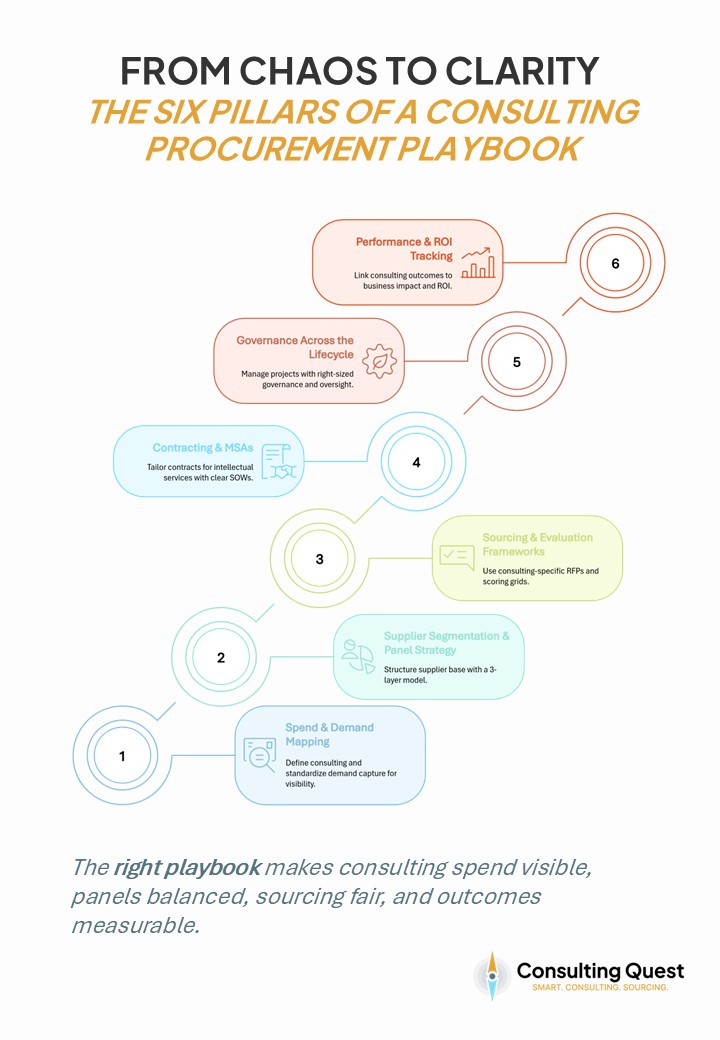
5. Governance Across the Lifecycle
In many organizations, governance is an afterthought. Only the largest projects get any kind of oversight. Smaller projects fly under the radar, and governance is often imposed by the consultants themselves. On the flip side, some clients try to treat consultants like internal staff — micromanaging them day to day, which defeats the purpose of bringing in outside expertise.
The playbook should define governance across the entire lifecycle:
- Before: validation, approvals, business case.
- During: milestones, steering committees, escalation protocols.
- After: post-project reviews, lessons learned, supplier evaluations.
At a basic level, governance may mean simply tracking sign-offs and budgets. At advanced levels, it means full project portfolio management — with systematic post-mortems, knowledge transfer, and supplier performance reviews.
The goal is balance: enough client involvement to ensure alignment and accountability, without smothering consultants.
6. Performance & ROI Tracking
Perhaps the biggest gap in most organizations: nobody measures consulting properly. At best, companies send out a generic satisfaction survey: “Rate your provider from 1–5.” These vanilla evaluations tell you almost nothing about the impact of a project.
A robust playbook should provide tailored evaluation frameworks for consulting:
- Were the project objectives achieved?
- Did the consultants transfer knowledge and build internal capabilities?
- How did stakeholders perceive collaboration and impact?
- What was the ROI — financial and non-financial?
At early maturity, this may mean running simple after-action reviews. At advanced maturity, it means dashboards linking project outcomes to strategic KPIs, with insights feeding directly into future sourcing decisions.
Without measurement, consulting is a cost. With measurement, it becomes an investment with visible returns. And that includes shining a light on areas often neglected, such as tail spend. For practical steps on managing this hidden value, read our guide on managing tail spend in consulting
👉 Key Takeaway
A consulting procurement playbook should not be a static binder of rules. It is a dynamic framework that adapts to maturity, clarifies what’s unique about consulting, and addresses the real-world pitfalls many companies face: hidden spend, unbalanced panels, vague RFPs, misfit contracts, weak governance, and superficial evaluations.
Get these six elements right, and the playbook becomes your single most powerful tool to bring structure, discipline, and value creation to consulting procurement.
Best Practices in Building & Using a Playbook
Designing a consulting procurement playbook is one thing. Making it work inside your organization is another. Too often, playbooks become binderware — thick PDFs created once, never updated, and quickly ignored. To avoid that fate, you need to think of the playbook as a périple, not a static deliverable.
Here are the five best practices to make it stick:
1. Start with Maturity Alignment & Quick Wins
The first step is to assess your maturity — otherwise you’re designing blind. Use tools like a consulting procurement maturity assessment to benchmark where you stand. From there, define where you want to go, and identify the quick wins you can capture immediately.
- At low maturity, a quick win might be clarifying what counts as consulting spend.
- At intermediate levels, it could be consolidating supplier lists or introducing basic RFP templates.
- At advanced levels, it might mean embedding systematic post-project reviews.
📌 Reality Check: Many companies overengineer playbooks. The better approach is to start simple, capture a few wins, and build credibility.
2. Involve Stakeholders from Day One
Executives and business leaders are the ones who trigger most consulting projects. If they don’t see value in the playbook, they’ll bypass it. The best practice? Make them part of the process.
- Invite stakeholders to take part in the maturity assessment.
- Ask them to co-create the roadmap and identify quick wins.
- Give them ownership of pieces of the playbook.
📌 Reality Check: When stakeholders co-own the playbook, adoption soars. When they feel it’s “procurement’s toy,” they’ll ignore it.
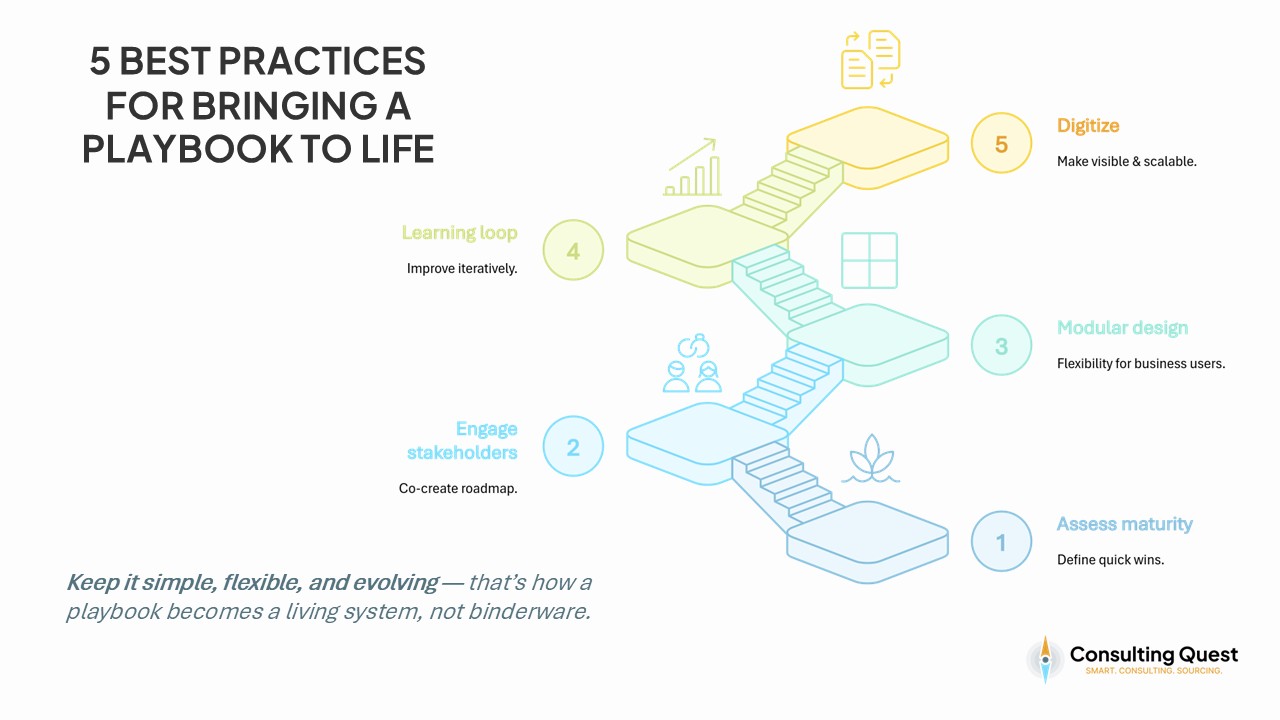
3. Keep It Modular & Flexible
Not every project needs the same level of rigor. Professional services teams are often small, and they can’t handle every project. If your playbook is rigid and centralized, you create bottlenecks — and that’s an instant killer.
- Design modular pathways: light processes for small projects, full processes for strategic ones.
- Provide tools that business buyers can use directly, without procurement holding their hand.
📌 Reality Check: Flexibility is not a weakness — it’s a survival tactic. Without it, stakeholders will bypass the process altogether.
4. Build a Learning Loop
You won’t get it right the first time — and that’s okay. A playbook should evolve with each project.
- Capture lessons learned after projects.
- Feed insights back into templates, supplier panels, and evaluation criteria.
- Show progress over time to build trust.
📌 Reality Check: Many organizations treat the playbook as “done” once published. The best ones treat it as version 1.0 of a living system that grows with them.
5. Embed Digitization Early
Finally, bring the playbook into the tools people already use. Digitization makes visibility immediate, without requiring a radical change in ways of working. It allows you to improve progressively while keeping control.
- Automate intake and approval flows.
- Digitize templates, contracts, and supplier scorecards.
- Use platforms built for consulting procurement (like Consource.io) that can scale with your maturity.
📌 Reality Check: Digital doesn’t replace the playbook, but it makes it usable. Without digitization, playbooks too often stay in drawers.
Common Pitfalls to Avoid
Even with the best intentions, many consulting procurement playbooks fail in practice. Why? Because organizations fall into predictable traps that undermine adoption, credibility, and impact. Let’s explore the most common pitfalls — and how to avoid them.
1. Overengineering the Playbook
It’s tempting to try to capture everything at once: every policy, every process, every exception. The result? A 100-page document no one has the time (or patience) to read.
In practice, overengineered playbooks often:
- Delay adoption because stakeholders feel overwhelmed.
- Create bottlenecks, as projects grind to a halt waiting for compliance with overly detailed steps.
- Send the wrong signal: that procurement cares more about control than about outcomes.
📌 Playbook Fix: Focus on usability over perfection. Start with a lean version covering the essentials — taxonomy, intake, panel usage, and contract templates. Once the basics stick, you can layer on complexity. Think “version 1.0,” not “the encyclopedia of consulting procurement.”
2. Undercooking the Framework
On the flip side, some organizations go too light. They produce a two-page checklist with vague advice like “engage suppliers competitively” or “track performance.” Without clear definitions, templates, or rules, stakeholders simply continue with business as usual.
Undercooked playbooks usually:
- Fail to change behavior — stakeholders don’t see why they should follow it.
- Lack credibility — executives perceive it as procurement window-dressing.
- Miss the chance to capture even the simplest savings and governance improvements.
📌 Playbook Fix: Be concrete. Even a lean playbook should include practical tools: an RFP template, supplier segmentation rules, or a performance review form. These are what make the playbook real and usable.
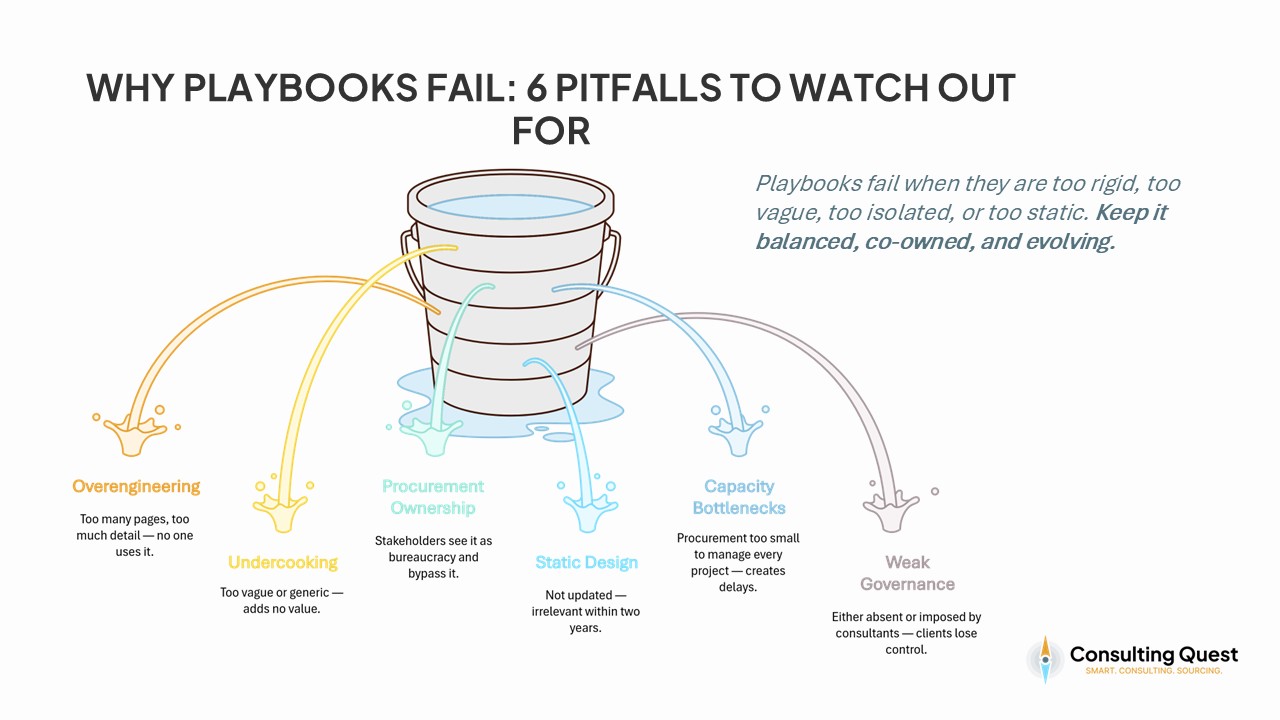
3. Procurement-Only Ownership
One of the biggest killers of playbook adoption is when procurement writes it in isolation and tries to enforce it top-down. Business leaders see it as bureaucracy and push back. Worse, executives — the ones who initiate most consulting projects — often bypass procurement entirely if they feel the playbook slows them down.
📌 Playbook Fix: Co-creation is non-negotiable. Involve stakeholders early, ask them to share the maturity assessment, and invite them to identify quick wins. When executives feel the playbook helps them — rather than polices them — they’ll use it.
4. Static by Design
Too many playbooks are treated like policy manuals: published once, celebrated with a launch webinar… and never updated. The consulting market evolves constantly — new entrants, alternative models, changing fee structures. Business priorities also shift fast. A static playbook becomes outdated within 18–24 months.
📌 Playbook Fix: Build a learning loop. Include governance for how the playbook is reviewed and updated — ideally after each major project or at least once a year. Capture lessons learned, update supplier scorecards, refresh templates. A living playbook stays credible and useful.
5. Ignoring Capacity Constraints
Professional services procurement teams are often small — sometimes just one or two people. If the playbook assumes procurement will manage every single project, it creates bottlenecks. Business buyers quickly lose patience and go around the process.
📌 Playbook Fix: Design with flexibility in mind. Create modular pathways: procurement-led for large, strategic projects; stakeholder-led (with light playbook guidance) for smaller ones. This keeps workload manageable and avoids bottlenecks.
6. Treating Governance as an Afterthought
Governance is often bolted on at the end — or worse, dictated by consultants themselves. Small projects slip through without oversight, while large projects get governance that’s too heavy-handed. The result? Misaligned expectations, lack of accountability, and missed learning opportunities.
📌 Playbook Fix: Make governance central, not peripheral. Define right-sized governance for all projects, not just big-ticket ones. Train project sponsors to own the steering role, balancing oversight with trust.
⭐ Key Takeaway
Playbooks fail when they are too rigid, too light, too isolated, or too static. Success comes from balance: practical tools, shared ownership, continuous improvement, and flexibility.
Why Getting Started Is the Hardest Part
Building a consulting procurement playbook can feel overwhelming. Consulting spend is often invisible, stakeholders are wary of losing control, and procurement teams in professional services are usually small and stretched thin. But here’s the truth: you don’t need to solve everything at once. The best playbooks start small, create visible impact fast, and expand over time.
Step 1 – Assess Your Maturity
The biggest mistake companies make is trying to design a playbook in the dark. Without a baseline, you risk writing something either too simplistic to matter or too sophisticated to be usable.
A consulting procurement maturity assessment helps you see:
- How consulting is currently categorized (or not categorized at all).
- Whether spend is visible across departments.
- How suppliers are managed (ad hoc vs. structured panels).
- Whether performance is tracked.
👉 In many organizations, this exercise uncovers surprises — like discovering that consulting spend is twice what leaders assumed, because half of it was hidden under time & material contracts.
Stakeholder tip: Don’t keep the assessment to procurement. Involve business leaders and executives — let them share their view of how things work today. This creates a shared baseline and avoids the perception that procurement is “grading” others.
Step 2 – Define Ambition and Quick Wins
Once you know where you are, ask: Where do we want to go? But don’t confuse long-term ambition with first steps.
- Ambition: Maybe in three years you want a global three-tier supplier panel, integrated dashboards, and post-project ROI measurement.
- Quick wins: But right now, you might simply need to define what counts as consulting, launch a standardized RFP template, or clean up supplier lists.
Capturing these quick wins is essential. They:
- Deliver visible results fast.
- Build credibility with stakeholders.
- Create momentum for bigger changes.
👉 Example: One organization reduced its “miscellaneous” consulting category by 40% within six months — simply by clarifying taxonomy and enforcing its use in purchase orders.
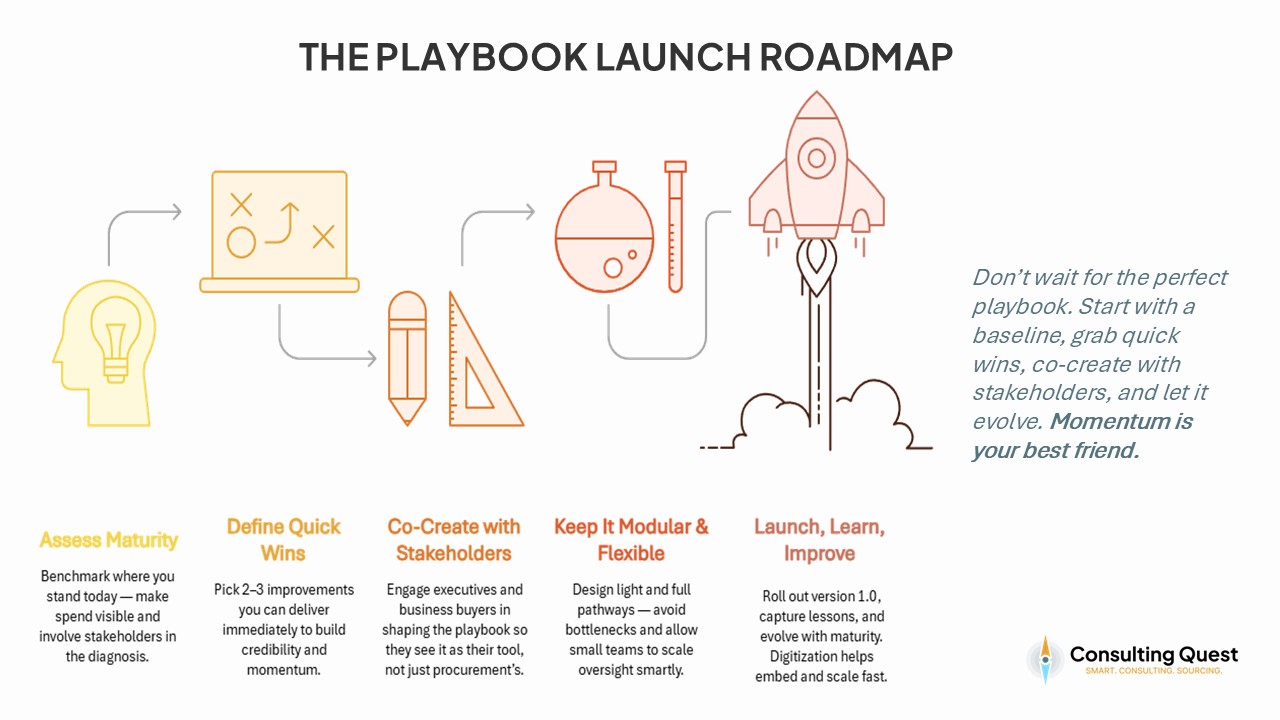
Step 3 – Co-Create with Stakeholders
Consulting projects rarely start in procurement. They start in the C-suite, in transformation offices, or in business units under pressure. If these stakeholders don’t buy into the playbook, they will ignore it.
That’s why co-creation is critical. Involve them in:
- Interpreting the maturity assessment.
- Identifying pain points (“what frustrates you about how we buy consulting today?”).
- Defining quick wins that serve their priorities.
When stakeholders see the playbook as a way to get better consultants, faster and with less friction, they’ll use it. If they see it as procurement red tape, they won’t.
Step 4 – Keep It Modular and Flexible
A one-size-fits-all playbook kills adoption. Professional services teams are often small, and they cannot realistically manage every project. Forcing all projects — from a €50k market scan to a €10m transformation — through the same funnel creates bottlenecks.
The smarter approach is modularity:
- A “light” track for small, tactical projects — business-led, with minimal procurement touch.
- A “full” track for large, strategic projects — procurement-led, with formal RFPs, panels, and governance.
- Clear decision rules for when to use each track.
👉 This flexibility prevents bottlenecks while keeping oversight where it matters most.
Step 5 – Launch, Learn, and Improve
Your first playbook will not be perfect — and that’s okay. What matters is launching, learning, and improving.
- Use early projects as pilots.
- Gather feedback from sponsors and suppliers.
- Capture lessons learned systematically.
- Update templates, panels, and governance rules accordingly.
Digitization helps accelerate this cycle. Embedding your playbook into platforms like Consource.io makes it visible, automates workflows, and provides data to refine processes — without demanding an overnight cultural revolution.
⭐ Key Takeaway
Don’t wait for the perfect playbook. Start with a baseline, grab quick wins, co-create with stakeholders, and let it evolve. Momentum is your best friend.
Conclusion – Turning the Playbook into a Strategic Lever
Consulting procurement is one of the trickiest categories to manage. It’s small in volume but massive in impact. Projects can shape strategy, reorganize operations, and define a company’s future. Yet too often, consulting spend is hidden, panels are unbalanced, sourcing is inconsistent, contracts are misaligned, governance is patchy, and performance is barely measured.
That’s why a consulting procurement playbook is not a “nice-to-have.” It is the single most effective tool for bringing structure, transparency, and discipline into this complex category.
A well-designed playbook does three things:
- Creates clarity — by defining what counts as consulting, how to source it, and who does what.
- Builds consistency — by providing frameworks, templates, and governance that everyone can follow.
- Drives value — by aligning procurement maturity with business priorities, ensuring that consulting delivers measurable ROI.
But here’s the secret: no playbook is perfect on day one. The best ones start small, win credibility with quick wins, and evolve with maturity. They are co-created with stakeholders, flexible enough to fit different project types, and refreshed regularly through learning loops and digitization.
In other words: a playbook is not a static manual. It’s a living system — the operating model for consulting procurement.
So, if you’re ready to bring order to consulting chaos and turn your spend into a strategic lever, now is the time to start.
👉 Take the first step: assess your maturity with our online Consulting Procurement Maturity Assessment.
👉 Go further: download our Consulting Procurement Playbook Checklist to begin shaping your own framework.
👉 Need a partner? Réservez une consultation gratuite with Consulting Quest and let’s build the playbook your organization deserves.
Don’t let consulting procurement run on autopilot. Write the playbook, own the game.


 English
  Français
  Português